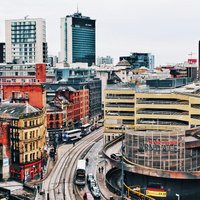

Manchester is the kind of city where you can walk the same route to work for five years and then someone mentions a medieval library or a hidden river and you realise you’ve been passing it every day without knowing. The obvious stuff – Old Trafford, the Northern Quarter, Piccadilly Gardens – is well-covered. This is the other stuff. The things that are hiding in plain sight, that even people who’ve lived here for years somehow miss. Fifteen of them, in no particular order, each one worth knowing about.
1. Chetham’s Library – The Oldest Public Library in the English-Speaking World
This is genuinely remarkable and genuinely overlooked. Chetham’s Library on Long Millgate, next to Victoria station, has been lending books since 1653. That makes it the oldest free public library in the English-speaking world. The building itself is medieval – it was originally a priests’ college built in 1421 and it looks like it. Dark oak shelves, chained books, reading alcoves that place’t fundamentally changed in four hundred years.
Karl Marx and Friedrich Engels used the library in the 1840s when they were researching what would become The Communist Manifesto. The alcove where they sat is preserved and you can see it. The most influential political document of the nineteenth century was partly researched in a medieval library in Manchester, and most people in the city have no idea. Chetham’s is open to visitors by appointment and the tours are free. There’s no excuse for not going.
2. Victoria Baths – You Can Actually Swim There
Victoria Baths on Hathersage Road in Longsight is one of the most beautiful buildings in Manchester and also one of the saddest. Opened in 1906, it was described at the time as a water palace. The interior is extraordinary – stained glass windows, decorative tilework, terracotta detailing, three separate swimming pools. It closed in 1993 because the council couldn’t afford the upkeep.
The building won the BBC’s Restoration programme in 2003 and has been slowly restored since. The key detail most people miss: on certain dates throughout the year, they fill one of the pools and you can actually swim in it. The experience of swimming in an Edwardian pool surrounded by original tilework and stained glass is unlike anything else in Manchester. Check their website for swim dates. They sell out. Book early.
3. The Pankhurst Centre
The house at 60-62 Nelson Street in Chorlton-on-Medlock is where Emmeline Pankhurst lived and where the suffragette movement was founded in 1903. The Women’s Social and Political Union held its first meeting in the parlour of this house. The modern democratic rights that half the population of this country exercise were planned in a terraced house in Manchester.
The Pankhurst Centre is a museum and community space now, run by a trust. It’s small, it’s underfunded, and it’s overshadowed by the larger suffragette exhibitions in London. But this is the actual house. The actual room. The place where it started. If you care about history at all, go.
4. The John Rylands Library Reading Room
People know the John Rylands Library on Deansgate exists. Fewer people have been inside it, and far fewer have sat in the reading room. The building is neo-Gothic, designed by Basil Champneys and opened in 1900, and the main reading room is one of the most beautiful interior spaces in England. Stone arches, dark wood, stained glass, and the kind of silence that makes you whisper even when nobody’s told you to.
The library holds some of the oldest printed books and manuscripts in existence, including fragments of the earliest known New Testament text. It’s part of the University of Manchester now and it’s free to visit. The reading room is open to anyone. You can sit at a desk, under those stone arches, and read. Or just look up at the ceiling and wonder why you’ve been going to coffee shops when this exists.
5. The River Beneath Deansgate
There’s a river running under one of Manchester’s main streets and most people have never heard of it. The River Medlock flows through south Manchester, enters the city centre near the Mancunian Way, runs underground beneath several streets including parts of Deansgate, and emerges near Castlefield before joining the Irwell. It was culverted – buried in a tunnel – during the nineteenth century to make room for development and to deal with the frankly horrendous pollution.
The Medlock isn’t the only buried river. The River Tib, which gave its name to Tib Street in the Northern Quarter, is entirely underground. It’s tiny – more a stream than a river – but it’s still flowing beneath your feet when you walk through the NQ. Manchester’s rivers were sacrificed for industrial development and most of them are still down there, in Victorian brick tunnels, in the dark.
6. The Bee in the Town Hall Floor
Manchester Town Hall is closed for refurbishment, so you can’t see this right now, but it’s worth knowing about for when it reopens. The floor of the Great Hall is decorated with a mosaic pattern that includes bees – the worker bee being Manchester’s symbol since the Industrial Revolution, representing hard work and cooperation. The bees are incorporated into the tile pattern of the floor in a way that’s easy to miss if you don’t know to look down.
The worker bee became a much more public symbol after the Arena bombing in 2017, when thousands of people got bee tattoos as a mark of solidarity. But the bee has been Manchester’s symbol since the 1800s, and it’s woven into the city’s architecture in dozens of places – on lampposts, on bollards, in mosaic floors, on the coat of arms. Once you start looking for bees in Manchester, you see them everywhere.
7. The Plague Stone at the Cathedral
On the south side of Manchester Cathedral, near the main entrance, there’s a flat stone set into the ground that most people walk over without noticing. It’s the plague stone. During outbreaks of plague in medieval Manchester, this stone was filled with vinegar, and people from outside the city would place their coins in the vinegar before trading with people inside it. The vinegar was believed to disinfect the money and prevent the plague from spreading.
It’s a small, unremarkable-looking stone, and there’s no dramatic plaque or sign drawing attention to it. But it’s a direct physical connection to medieval Manchester, to a time when the city was a small market town and disease could wipe out half the population. Stand on it and think about that for a moment. Then think about how many thousands of people walk over it every day without knowing.
8. Elizabeth Gaskell’s House
The house at 84 Plymouth Grove where Elizabeth Gaskell lived from 1850 to 1865 is open as a museum, and it’s better than most people expect. Gaskell wrote some of the most important novels of the Victorian era here – North and South, Cranford, Wives and Daughters. Charlotte Brontë visited. Charles Dickens came for dinner. The house is a Regency villa that’s been carefully restored, and the guided tours are run by volunteers who know more about Victorian Manchester than most academics.
The house is slightly off the beaten track in Ardwick, which is probably why it doesn’t get more visitors. But Gaskell is one of Manchester’s most significant literary figures, and her writing about industrial Manchester is as relevant now as it was in the 1850s. She wrote about poverty, class, the relationship between workers and factory owners, and the human cost of industrialisation. If you want to understand what Manchester was, and in some ways still is, read Gaskell and visit her house.
9. The Portico Library
On Mosley Street, above a shopfront you’ve probably walked past without looking up, there’s a subscription library that’s been operating since 1806. The Portico Library is a Georgian – a domed reading room with galleries, original bookcases, and the kind of atmosphere that makes you want to cancel your afternoon plans and just sit there reading.
It was originally a private library for Manchester’s merchants and industrialists. Now it operates as a membership library and cultural venue. You can visit for events, exhibitions, and occasional open days without being a member. The building alone is worth seeing – it’s one of the finest Georgian interiors in Manchester, hidden above street level where nobody thinks to look.
10. The Marble Arch Pub’s Interior
The Marble Arch pub on Rochdale Road is known to beer drinkers because it’s attached to the Marble brewery. What’s less well known is that the interior is one of the finest pub interiors in the country. The tiled walls and floor, the sloping mosaic floor (it’s built on a hill, so the floor genuinely slopes), the Art Nouveau glazed tilework – it’s a Grade II listed building and the interior is substantially original. CAMRA puts it on their list of historically important pub interiors, and they’re right.
11. Angel Meadow – Manchester’s Forgotten Graveyard
Angel Meadow is a small park off Rochdale Road in the NOMA district. It looks like an unremarkable green space. Underneath it are the remains of roughly 40,000 people. The area was a mass graveyard for Manchester’s poor in the eighteenth and nineteenth centuries. Irish famine refugees, factory workers, children who didn’t make it past infancy – they were buried here in conditions that were grim even by Victorian standards. Engels wrote about Angel Meadow’s surrounding slums in his study of working-class conditions in Manchester.
The park is quiet and slightly eerie if you know what’s beneath it. There’s a small information board but nothing that fully conveys the scale. Forty thousand people, in a space you can walk across in two minutes. It’s one of the most historically significant sites in Manchester and most locals have never heard of it.
12. The Thirlmere Aqueduct Marker Stones
Manchester gets its water from the Lake District, specifically from Thirlmere reservoir, via an aqueduct that runs nearly a hundred miles entirely by gravity. No pumps. The Victorians engineered it so that the water flows downhill the entire way from Cumbria to Manchester. It was completed in 1894 and it still works.
Along the route, there are marker stones, and some of them are visible in Greater Manchester if you know where to look. The aqueduct itself runs underground through parts of south Manchester, and the occasional inspection hatch or marker post is the only surface evidence of this extraordinary piece of Victorian engineering happening beneath your feet.
13. The Alan Turing Memorial Bench
Most people know about the Alan Turing statue in Sackville Gardens, sitting on a bench with an apple. Fewer people sit on the bench and look at what’s actually inscribed on it. The bench is positioned facing the place where Turing was arrested, and the inscription includes the Enigma code. It’s a quietly devastating memorial – the man who broke the Nazi codes and arguably shortened the war by years, chemically castrated by the British government for being gay, dead at forty-one.
Sackville Gardens itself is worth knowing as a quiet green space in the middle of the Gay Village. It’s a memorial garden with several monuments, and it’s one of the more peaceful spots in the city centre, especially on weekday mornings when the Village is quiet.
14. The Free Trade Hall Ghost Sign
The Free Trade Hall on Peter Street is now a Radisson hotel, which is one of Manchester’s more depressing adaptive reuse stories. But look at the building’s facade carefully and you can still see traces of its history. The building hosted the Sex Pistols’ famous 1976 gig, the Halle Orchestra, Bob Dylan going electric, and political rallies dating back to the Anti-Corn Law League in the 1840s. The name ‘Free Trade Hall’ itself is political – it commemorates the free trade movement that originated in Manchester.
Around the building and on nearby streets, there are ghost signs – faded painted advertisements on brick walls from the Victorian and Edwardian eras. They’re easy to miss but they’re everywhere in central Manchester if you look above street level. Old advertisements for long-dead businesses, painted directly onto brick, slowly fading but still legible. Each one is a tiny piece of commercial archaeology.
15. The Godlee Observatory
On the roof of the Sackville Street Building at the University of Manchester (the old UMIST campus), there’s a working astronomical observatory that’s been there since 1903. The Godlee Observatory has a six-inch refracting telescope in a traditional dome, and the Manchester Astronomical Society runs regular public observing sessions. You can look through a telescope at Saturn’s rings or Jupiter’s moons from the roof of a building on a busy Manchester street, and most people in the city have absolutely no idea it’s up there.
The observing sessions run on clear Thursday evenings during the winter months. They’re free. The volunteers are knowledgeable and friendly. And the experience of standing on a rooftop in central Manchester, looking through a century-old telescope at a planet millions of miles away, is the kind of thing that makes you feel differently about the city you live in. It’s been up there since 1903, quietly pointing at the sky, waiting for people to notice. Most never do.
The Point of All This
Manchester is good at the obvious. The music history, the football, the bars and restaurants, the nightlife – all of that is well-documented and well-promoted. What’s less well-documented is the depth beneath the surface. A city where you can visit the oldest public library in the English-speaking world, swim in an Edwardian water palace, stand over a medieval plague stone, and look at Saturn through a rooftop telescope, all in the same day, has more layers than its reputation suggests.
Most of these places are free. Most are open to the public. Most are within walking distance of the city centre. The only thing stopping you is not knowing they’re there, and now you do. Go find them.
Corrections
Spotted something wrong? Send a correction.