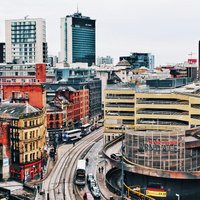

Every city has a public space that it can’t quite get right. Manchester’s is Piccadilly Gardens. It’s the geographical heart of the city, the point where the tram lines cross, the place where every bus route seems to pass through, the square that tens of thousands of people walk across every single day. It should be Manchester’s equivalent of a European piazza – a civic gathering space that the city is proud of. Instead, it’s the thing Mancunians apologise for.
This is not a hit piece on Piccadilly Gardens. Nor is it a defence. It’s an honest attempt to work out why a space this central and this important has been this disappointing for this long.
What It Used to Be
The name gives it away: gardens. Piccadilly Gardens was, originally, an actual garden. In the Victorian era, it was a formal park with trees, flowerbeds, a fountain, and an infirmary that was later demolished. Through the early and mid-twentieth century, it was a green space in the city centre – not spectacular, but pleasant enough. There were benches, grass, mature trees, and the kind of quiet urban greenery that lets a city breathe.
Photographs from the 1950s and 1960s show a conventional municipal garden: people sitting on benches, pigeons, flower borders, the statue of Queen Victoria presiding over it all. It wasn’t remarkable, but it worked. It was green space in a grey city, and people used it.
The sunken garden, added in the 1960s, was well-liked. The layout gave structure to the space without over-designing it. There were places to sit, things to look at, and enough greenery to justify the name. It wasn’t perfect – maintenance was patchy and parts of it looked tired by the 1990s – but the bones were good.
The Redesign That Nobody Wanted
In 2002, Manchester City Council completed a major redesign of Piccadilly Gardens. The project cost around £20 million. The centrepiece was a pavilion building (housing a restaurant) and, most controversially, a curved concrete wall designed by the Japanese architect Tadao Ando.
Tadao Ando is a Pritzker Prize winner. His work in Japan is extraordinary – minimalist concrete structures that play with light and water in ways that are genuinely beautiful. The Piccadilly Gardens wall was supposed to bring that sensibility to Manchester. A clean, curved concrete form that would create a sheltered space and add architectural distinction to the square.
In practice, it’s a grey concrete wall in a grey city where it rains two hundred days a year. The concrete stained almost immediately. The sheltered space behind it became a gathering point for rough sleepers and drug users – not because there’s anything wrong with those people, but because the design created a hidden, semi-enclosed area that was exactly the wrong thing for a public space with existing anti-social behaviour problems.
The wall became Manchester’s most hated piece of architecture almost overnight. Petitions were launched to demolish it. Council meetings debated it. Opinion polls consistently showed that Mancunians wanted it gone. More than twenty years later, it’s still there. The pavilion building that accompanied it was demolished in 2024, but the wall remains, a monument to the gap between architectural ambition and urban reality.
The Anti-Social Behaviour Problem
Piccadilly Gardens has had anti-social behaviour issues for decades, and it’s important to be honest about this without being cruel. The square is a confluence point – transport hub, meeting place, thoroughfare – and those spaces attract everyone, including people who are homeless, people with addiction issues, and people in mental health crisis.
The visibility is what makes it feel worse than it might be. Someone in distress in Piccadilly Gardens is seen by thousands of people. The same situation in a less central location goes unnoticed. The square’s reputation as unsafe or unpleasant is partly a function of its centrality – you can’t avoid it, so you can’t avoid seeing the things that other public spaces hide.
That said, the design hasn’t helped. The concrete wall created sheltered corners. The water feature (a shallow fountain that was popular with children) was turned off repeatedly due to maintenance issues and concerns about misuse. The lack of permanent food and drink outlets with outdoor seating – the kind of active frontages that make European squares work – means there’s nothing to anchor positive use of the space. People pass through Piccadilly Gardens. They don’t linger, unless they have nowhere else to go.
Why Every Fix Has Failed
Manchester has tried multiple interventions. Additional policing. CCTV. Design tweaks. A ‘temporary’ park with artificial grass. Events programming. None of it has fundamentally changed the experience of being in Piccadilly Gardens.
The problem is structural. The space is caught between competing functions: it’s a transport interchange, a pedestrian thoroughfare, a green space, a meeting point, and an events venue. Trying to be all of those things at once means it does none of them well. The tram tracks cut through the middle. The bus stops line the edges. The flow of people is constant and fast. There’s no invitation to stop.
European cities solve this by separating functions. The piazza is for people. The transport hub is underground or adjacent. The green space is protected. Manchester has everything layered on top of each other in one square, and the result is noise, clutter, and a sense that the space belongs to nobody.
There’s also the ownership question. Parts of Piccadilly Gardens are privately owned – the long-term lease held by a property company has complicated every attempt at comprehensive redesign. The council’s ability to transform the space is constrained by private interests, which is a problem when the public interest is so obviously crying out for change.
What Could Actually Work
The conversation about Piccadilly Gardens has been going on for so long that even the proposals have proposals. But a few principles seem obvious.
First, demolish the wall. This should have happened years ago. Whatever architectural merit it had on paper, it doesn’t work in Manchester. The concrete is stained, the space behind it is problematic, and the public has made its feelings clear for over two decades.
Second, bring back actual gardens. Not artificial grass or temporary planters, but proper planting, mature trees, and permanent green infrastructure. The name is Piccadilly Gardens. Make it one. Trees provide shade, reduce noise, improve air quality, and make people want to spend time in a space. Every successful urban square in the world has greenery. This shouldn’t be controversial.
Third, active edges. Cafés, restaurants, and kiosks with outdoor seating. People sitting and eating and drinking create natural surveillance and make a space feel safe and used. The absence of good food and drink options in Piccadilly Gardens is baffling for such a central location.
Fourth, resolve the ownership issues. A public square this important cannot be held hostage by private lease arrangements. If that means buying back the lease, it’s worth the money.
The Paradox
Here’s the strange thing about Piccadilly Gardens: Mancunians hate it and use it constantly. It’s the default meeting point. ‘See you in Picc Gardens’ is a phrase uttered thousands of times a day. The tram stops are the busiest in the Metrolink network. The green space, such as it is, fills up on sunny days. People eat lunch there. Kids play in the fountain when it’s working. Office workers cut through it twice a day.
The space functions despite itself. It functions because of its location, not because of its design. Put a patch of grass in the exact centre of a city and people will use it regardless of what you’ve done to the surroundings. That’s not a defence of the current design – it’s an indication of how much better it could be if the design actually supported the use.
Piccadilly Gardens is Manchester’s great missed opportunity. A square this central, this connected, this used, could be one of the best public spaces in Britain. Instead, it’s the thing Mancunians explain away to visitors. ‘It’s not usually this bad,’ we say, knowing full well that it is usually exactly this bad. The city deserves better, and the people who cross it every day certainly do. Whether the political will exists to make it happen is another question entirely.
Corrections
Spotted something wrong? Send a correction.