Start at the top of Deansgate, by the Cathedral, and walk south. By the time you reach the canal basin at Castlefield, you’ll have passed through something like six centuries of Manchester architecture, watched the skyline shift from medieval sandstone to glass and steel, and probably been nearly clipped by a bus. That’s Deansgate. One road, the whole story of Manchester told in bricks, stone, iron, and increasingly, cladding.
No other street in the city covers this much ground — historically or architecturally. London Road is longer but less interesting. Market Street is busier but architecturally dead. Oxford Road has the universities but nothing older than the 1800s. Deansgate is the spine. Everything else grew outward from it.
The Cathedral End — Where It Starts
The name gives the game away. Deansgate — the dean’s road, the route to the Cathedral. The top end is where Manchester began, and the buildings here still carry that weight. Manchester Cathedral itself sits just off to the east, a medieval collegiate church that’s been patched, bombed (the 1940 Blitz took out most of the interior), and rebuilt so many times that calling any part of it “original” requires qualification. But the footprint is 15th century, and standing in the nave still connects you to a Manchester that existed before cotton, before industry, before everything that made the city famous.
Directly opposite the Cathedral sits Chetham’s Library and School of Music. Chetham’s Library has a genuine claim to being the oldest free public reference library in the English-speaking world — it opened in 1653, funded by Humphrey Chetham’s will. The reading room where Marx and Engels sat working through economic texts in the 1840s is still there, still functioning, still open to visitors. The desks are the same ones they used. That’s not a reconstruction or a replica. That’s the actual furniture where two men sat and developed ideas that would reshape the entire world.
The medieval and Tudor buildings around here — half-timbered, low-ceilinged, the kind of structures that make you duck through doorways — feel like a different city entirely from what comes next. Which is exactly the point. Walk fifty metres south and you’re in a different century.
The Victorian Commercial District
The shift happens fast. By the time you pass the junction with St Mary’s Gate, the architecture has jumped forward three hundred years. This is where Victorian Manchester announced itself to the world, and it did so with all the subtlety of a brass band.
The buildings along this stretch are commercial Victorian at its most confident. Warehouses that were built to store cotton and textiles but were designed to look like Florentine palaces. The Victorians who built Manchester’s commercial district weren’t shy about what they were doing — they were creating a city to rival anything in Europe, and they wanted the architecture to say so. Red brick, terracotta, Portland stone, elaborate cornices, columns that serve no structural purpose whatsoever. Every building is a statement.
Barton Arcade is the jewel of this stretch. Built in 1871, it’s a glass-domed iron-framed shopping arcade that looks like it should be in Milan rather than standing between a Greggs and a phone repair shop. The ironwork is extraordinary — delicate, confident, engineered with the precision that Manchester applied to everything during its industrial peak. Stand in the middle and look up. The glass dome lets in a quality of light that makes you forget you’re in a city where it rains 150 days a year.
Barton Arcade nearly got demolished in the 1970s. The fact that it survived is down to the conservation movement that was just starting to push back against the post-war attitude that anything Victorian was disposable. Manchester lost dozens of buildings of this quality before people started saying no. Barton Arcade was one of the lucky ones.
Kendals, King Street, and the Money District
Further down, the old Kendals department store building — now House of Fraser, and who knows for how much longer given the state of department store retail — occupies a massive block. Kendals was Manchester’s answer to Selfridges, the place where middle-class Manchester went to buy things it couldn’t afford. The building is Edwardian, solid, and carries the kind of commercial confidence that modern retail architecture completely lacks. Say what you like about department stores as a business model, but the buildings they left behind are better than anything a shopping centre has ever produced.
Just off Deansgate, King Street runs east. This was Manchester’s banking district — every major bank had its headquarters or regional office here, and the buildings reflect that. Marble lobbies, grand facades, the architecture of institutions that wanted you to feel small when you walked in to ask for a loan. Most of the banks have gone now, replaced by restaurants, bars, and the occasional high-end retailer. The buildings remain, and they’re still impressive even when they’re housing a cocktail bar instead of a vault.
The Rylands Library — The Best Building on the Street
John Rylands Library sits on the west side of Deansgate, and if you walk past it without going in, you’ve made a mistake. Built between 1890 and 1899 by Enriqueta Rylands as a memorial to her husband (a textile manufacturer whose fortune paid for the whole thing), it’s a neo-Gothic cathedral to books. The architect, Basil Champneys, designed it to look and feel like a medieval church, and he succeeded completely.
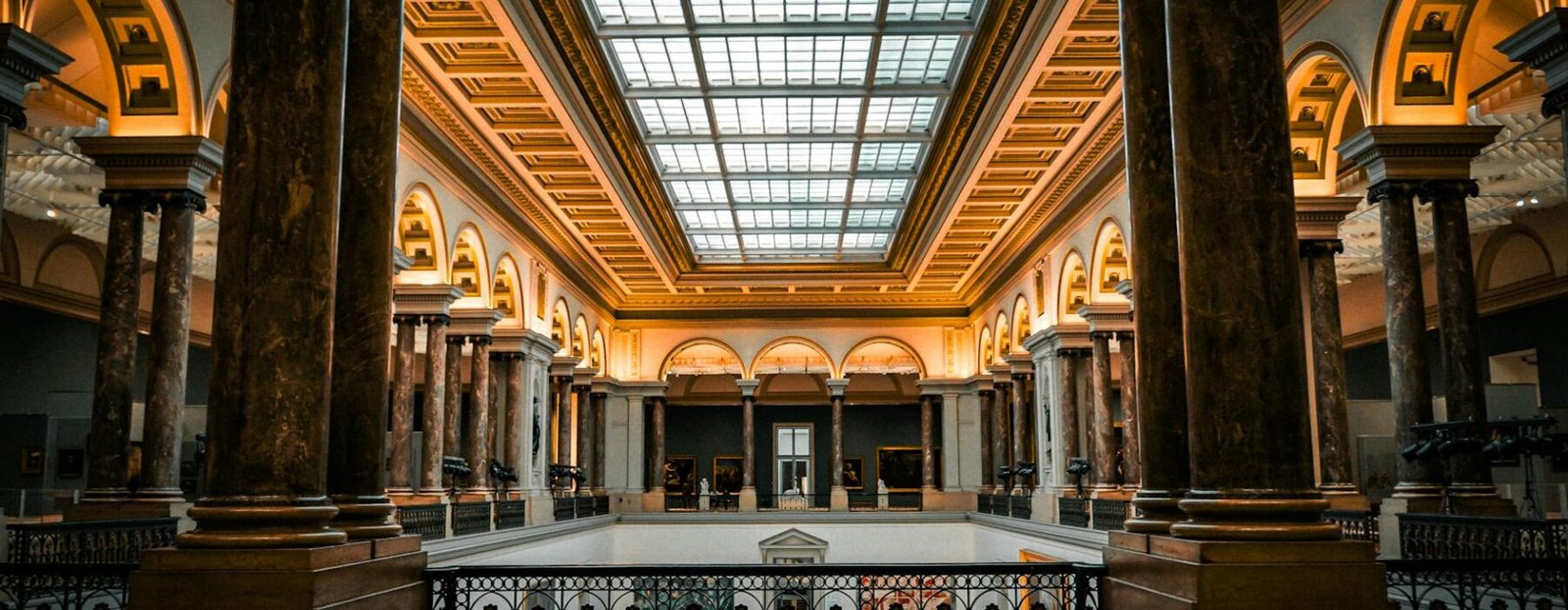
Inside, the main reading room has the atmosphere of a place where silence is a structural element. Stone columns, stained glass, wooden reading desks with brass lamps. The library holds some of the oldest printed books in existence, including a fragment of St John’s Gospel from around 125 AD — the oldest known piece of the New Testament. It sits in a display case on the ground floor, and most people walk past it without realising what they’re looking at.
The Rylands is free to enter. It’s been part of the University of Manchester’s library system since 1972, but it functions equally as a public building. Go on a weekday morning when it’s quiet. The reading room, with light coming through the windows and the smell of old stone, is one of the finest interior spaces in England. That’s not Manchester boosterism. It’s just true.
St Ann’s Church and the Square
St Ann’s Church, just off Deansgate to the east, dates from 1712. It’s Georgian, which makes it unusual in a city that’s mostly Victorian. The church sits in St Ann’s Square, which functions as Manchester’s closest equivalent to a continental European piazza — a public space surrounded by commercial buildings where people sit, eat lunch, and pretend the weather is better than it is.
The square’s Christmas markets have turned it into one of the most photographed spots in Manchester every November and December. For the rest of the year, it’s a quieter space than you’d expect given its central location. The church itself holds regular concerts and events, and the interior — plain, elegant, no Victorian excess — is a reminder that Manchester existed before the Industrial Revolution turned it into a powerhouse.
The Beetham Tower Moment
As you continue south on Deansgate, the skyline changes. The Beetham Tower — 47 floors, 169 metres, completed in 2006 — was the building that signalled Manchester’s vertical ambitions. Before Beetham, the city was essentially flat. The CIS Tower from 1962 was the only real high-rise in the centre, and it was an office block that nobody thought twice about.
Beetham changed everything. Ian Simpson, the architect, put his own penthouse at the top — a move that was either supreme confidence in his own work or the most expensive bet in Manchester property history. The building divided opinion when it went up. Some people thought the cantilevered glass blade at the top was brilliant. Others thought it looked like an unfinished filing cabinet. The humming noise the blade makes in high wind — a low, resonant drone that carries for blocks — became an unexpected feature that the building has never been able to fix.
Love it or not, Beetham set the template. After it went up, developers realised Manchester would accept tall buildings, and the skyline has been racing upward ever since. Owen Street Tower, Elizabeth Tower, the Deansgate Square cluster — all of them owe their existence to Beetham proving the concept.
Deansgate Square and the New Towers
The southern stretch of Deansgate has been transformed in the last decade. Deansgate Square — four residential towers, the tallest reaching 201 metres — has created a cluster of glass high-rises that would look at home in any major global city. The South Tower is currently the tallest building in Manchester, and the tallest residential building in the UK outside London.
Whether you think this is progress depends on your feelings about residential towers that most Manchester residents can’t afford to live in. The apartments are largely bought by investors — many from overseas — and occupancy rates have been a subject of debate. Walking through the base of Deansgate Square on a Tuesday evening, you notice a lot of dark windows. The buildings are impressive as objects. As homes for a community, the jury’s out.
But architecturally, they’ve given Manchester a skyline. Approach the city from the south or west and those towers announce that this is somewhere that takes itself seriously. Fifteen years ago, the same approach gave you a view of car parks and railway arches.
The Locks and Castlefield
The bottom of Deansgate drops down to the canal basin at Castlefield, and the shift in atmosphere is dramatic. After a mile of commercial buildings, towers, and traffic, you’re suddenly among canal locks, railway viaducts, and the remains of the Roman fort that gave Manchester its name — Mamucium.
The Castlefield viaducts are among the most impressive pieces of Victorian engineering in the city. Multiple railway lines cross the basin on brick and iron structures that have been carrying trains since the 1840s. They were built to last, and they have. Standing underneath them, looking up at the brickwork, you get a sense of the scale of confidence that Victorian Manchester operated on. These weren’t temporary structures. They were built by people who assumed their city would matter forever.
The canal basin itself is now surrounded by bars, restaurants, and apartments. The Grocer’s Warehouse and the Middle Warehouse have been converted from industrial use. The Bridgewater Canal — the first true canal of the Industrial Revolution, opened in 1761 — still runs through here. On a summer evening, people sit by the water and drink, and the combination of Victorian iron, canal water, and warm light creates something genuinely beautiful.
The Locks development — residential towers by the canal — continues the transformation of this end of Deansgate from post-industrial wasteland to expensive real estate. The pattern is the same as everywhere in Manchester: industry goes, apartments come, and the question of who gets to live in the new city remains unanswered.
One Street, One City
The thing about walking the full length of Deansgate is that nobody makes you do it all at once. You can spend a morning at the Cathedral end, have lunch near King Street, and come back another day for the Rylands and Castlefield. But doing it in one go — top to bottom, about forty minutes if you don’t stop — gives you something no other street in Manchester can offer: the whole story, told in sequence, without having to catch a bus.
Medieval stone to Georgian brick to Victorian excess to Edwardian confidence to post-war concrete to 21st century glass. Every era of Manchester is here, pressed up against the next, arguing about who matters most. The answer, as with most arguments in Manchester, is that everyone thinks they’re right and nobody’s backing down.