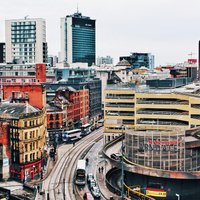

Stand on any rooftop in Manchester city centre and count the cranes. On a clear day – admittedly rare – you’ll see a dozen or more, scattered across the skyline like steel birds that forgot how to migrate. Every one of them represents someone’s bet that Manchester’s future is worth investing in. Some of those bets are good. Some are speculative. And some are the kind of developer-driven optimism that treats every problem as an opportunity to build luxury apartments.
What follows is an honest assessment of what’s coming to Manchester between now and 2030. The developments that will genuinely change the city, the projects that are mostly marketing, and the infrastructure decisions that will determine whether Manchester becomes a better place to live or just a more expensive one.
Town Hall Refurbishment – The Homecoming
The biggest deal first. Manchester Town Hall has been closed since 2024 for a full-scale restoration that’s one of the largest heritage building projects in the UK. The Grade I listed Waterhouse masterpiece needed work badly – the stonework was deteriorating, the building services were ancient, and decades of modifications had created internal problems that cosmetic fixes couldn’t solve.
The restoration is expected to complete in late 2026 or 2027, and when it does, Manchester gets back its civic heart. The Great Hall with its Ford Madox Brown murals, the council chambers, the public spaces – all restored and reopened. The building will also have improved accessibility and updated mechanical systems, meaning it should function as a working civic building for another century rather than slowly falling apart like it was before.
The cost has risen since the project was announced – these things always cost more than the initial estimate, and anyone who tells you otherwise has never been involved in a heritage restoration. But the result should be worth it. The Town Hall is Manchester’s most important building, and having it back in public use will change the character of Albert Square and the city centre as a whole.
Verdict: genuinely exciting. This is Manchester getting its best building back.
Factory International / Aviva Studios – Finding Its Feet
Aviva Studios, the home of Factory International, opened in 2023 after years of delays and cost overruns that made it Manchester’s most controversial cultural project. The building, designed by OMA (Rem Koolhaas’s firm), is a massive flexible performance space on the banks of the Irwell – a venue that can configure itself for anything from intimate theatre to large-scale immersive installations.
The opening – with Danny Boyle’s “Free Your Mind” inspired by The Matrix – was ambitious, expensive, and divisive. Some people loved it. Others thought it was a lot of money spent on something that felt more like a tech demo than art. Since then, the programming has been finding its way. There have been strong shows and weaker ones, and the venue is still working out what it is and who it’s for.
The next few years will be decisive for Factory International. If the programming finds a consistent identity – and there are signs it’s getting there – the venue could become genuinely important, a space where Manchester-scale ambition meets art. If it defaults to safe corporate events and touring exhibitions, it’ll be an expensive building that doesn’t justify the investment.
The building itself is impressive as architecture. Whether it becomes an essential part of Manchester’s cultural life depends on what happens inside it, not what it looks like from outside.
Verdict: too early to call. The potential is enormous. The execution needs to match.
Victoria North – The Biggest Residential Bet
Victoria North is the development that will change Manchester’s geography more than anything else. A joint venture between Manchester City Council and Far East Consortium, the plan is to build more than 10,000 new homes across a massive site stretching from the city centre northward through Collyhurst and New Cross.
The scale is hard to overstate. Victoria North will essentially create new neighbourhoods where previously there were post-industrial gaps, disconnected housing estates, and the kind of urban fabric that decades of underinvestment had left frayed. The development includes parks, schools, commercial space, and transport links, and the masterplan covers an area larger than most town centres.
The questions, as with all massive residential developments, are about affordability and community. Who gets to live in the 10,000 new homes? At what price? The development includes affordable housing, but the definition of “affordable” in Manchester property terms often bears little relationship to what people on average wages can actually pay. If Victoria North creates a new neighbourhood that existing Manchester residents can’t afford to live in, it’s a development for investors, not the city.
The Collyhurst element is particularly sensitive. Collyhurst is an established community with a long history, and the idea of a massive development transforming the area raises legitimate concerns about displacement and the loss of existing social networks. The council says existing residents will benefit. Residents are waiting to see.
Verdict: the scale is impressive and the area genuinely needs investment. Whether it becomes a community or a development is the question that matters.
ID Manchester – The University District
ID Manchester is a joint project between the University of Manchester and Bruntwood SciTech to create an innovation district on the old BBC and university land south of the city centre. The vision is a neighbourhood where academic research, commercial innovation, and everyday life overlap – labs next to cafes, startups next to lecture halls, the kind of mixed-use development that turns a campus into a place.
This is a long-term play. The full development will take years to complete, and the early phases are focused on establishing the infrastructure and the first wave of buildings. The theory behind innovation districts is well-established – proximity between universities and businesses generates the kind of informal collaboration that accelerates research and creates jobs. Whether that theory holds in Manchester specifically depends on getting the mix right.
The site is well-located – close to Oxford Road station, within walking distance of the city centre, connected to the university’s existing facilities. If it works, ID Manchester could make the city a serious contender in sectors like health tech, advanced materials, and digital innovation. If it doesn’t, it’ll be another business park with good marketing.
Verdict: smart in theory, dependent on execution. Worth watching over the next five years.
St Michael’s – Gary Neville’s Vision
The St Michael’s development, backed by Gary Neville and Ryan Giggs through their Relentless property company, has been one of the most debated projects in Manchester for years. Located between Deansgate and Albert Square, the plan includes a tall tower, a five-star hotel, offices, residential space, and public realm improvements.
The development has gone through multiple redesigns after earlier versions were rejected for being too tall and too dominant on the skyline near the Town Hall. The current scheme is more modest in height but still significant – a mixed-use development that will change the character of an area that’s currently a bit of a dead zone between Deansgate and Albert Square.
The controversy has centred on what was demolished to make way for the development. The former Bootle Street police station and parts of the existing streetscape were cleared, and heritage campaigners argued that the losses weren’t justified by what’s replacing them. Neville and his team argue that the development will bring life and investment to an underused part of the city centre. Both sides have points.
Verdict: will probably improve the area when finished. The heritage losses were real and shouldn’t be glossed over.
The Bee Network – Buses Come Home
Of everything on this list, the Bee Network might be the one that most changes daily life for actual Manchester residents. Greater Manchester’s buses are being brought back under public control – franchised, with routes, fares, and timetables set by the combined authority rather than private operators chasing profitable routes and ignoring the rest.
Andy Burnham has made this a centrepiece of his mayoralty, and the rollout has been happening in stages. The yellow Bee Network buses are already running on several routes, and the plan is for full coverage across Greater Manchester. For people who rely on buses – which in Greater Manchester means hundreds of thousands of people – this is the most significant transport change in decades.
The promise is simple: consistent fares, coordinated routes, integrated ticketing across buses, trams, and eventually trains. The reality will depend on whether the funding holds up and whether the operational challenges of running a unified bus network prove manageable. London has had franchised buses for years and they work well. Manchester is the first city outside London to go down this route, so there’s no other English model to learn from.
The early signs are cautiously positive. Buses are running. Routes that private operators abandoned are being restored. Fares are capped. Whether this holds up under financial pressure – and financial pressure is coming, it always is – will determine whether the Bee Network is a transformation or a temporary improvement.
Verdict: the single most important quality-of-life improvement on this list. Deserves to succeed.
HS2 and Northern Powerhouse Rail – The Transport Question Mark
HS2 to Manchester is, at the time of writing, officially still happening. The eastern leg was cancelled. The route beyond Birmingham has been repeatedly questioned, delayed, and redesigned. Whether a high-speed train will ever actually run from London to Manchester Piccadilly is a question that nobody in government seems willing to answer clearly.
Northern Powerhouse Rail – the east-west line connecting Liverpool, Manchester, and Leeds – is in a similar state of uncertainty. The full plan would dramatically improve cross-Pennine connectivity, but the full plan costs billions and successive governments have been reluctant to commit. The fear in Manchester is that NPR will be quietly downgraded until the “transformation” amounts to slightly faster trains on existing tracks.
Manchester’s economic future depends partly on connectivity. The city can’t grow into a genuine counterweight to London if it takes three hours to get to Leeds by train and the only reliable route south is a car on the M6. HS2 and NPR were supposed to fix this. The question is whether the political will exists to pay for it.
Verdict: essential infrastructure that Manchester needs. Whether it actually gets built is a political question that nobody in the city can answer.
Co-op Live – The Ripple Effects
Co-op Live has been open since 2024 and the immediate impact is clear: Manchester now has two major arenas competing for the biggest tours, which means more shows and – in theory – better pricing through competition. The AO Arena has been pushed to raise its game, and the net effect for audiences has been positive.
The longer-term impact is about the Eastlands area. Co-op Live sits near the Etihad Stadium, and together they’re creating an entertainment district in east Manchester that didn’t exist before. Whether this pulls activity away from the city centre or complements it is still playing out. Some city centre venues worry about competition from a shiny new venue with better facilities. Others argue that more capacity grows the overall market.
The venue itself, after its troubled opening, has settled into being a genuinely good arena. The sight lines are better than the AO Arena, the sound is cleaner, and the facilities are modern in a way that makes the AO feel its age. Whether Manchester needs two arenas of this size is debatable. Whether it’ll use them both is not – the bookings are strong and the shows keep coming.
Verdict: already making a difference. The Eastlands entertainment district is real and growing.
Honest Assessment
Manchester’s development pipeline between now and 2030 is enormous. Some of it is genuinely transformative – the Town Hall, the Bee Network, Victoria North’s scale. Some of it is promising but unproven – Factory International, ID Manchester. Some of it is standard developer activity dressed up in aspirational language – another glass tower, another “luxury living” brochure, another CGI image of happy people walking through a sun-drenched plaza that will actually be a wind tunnel nine months of the year.
The risk for Manchester is that it develops quickly without developing well. More buildings don’t automatically mean a better city. More homes don’t automatically mean homes for the people who need them. More transport infrastructure doesn’t automatically mean transport that works for everyone. The decisions being made now – about affordability, about public space, about who benefits from growth – will determine whether Manchester in 2030 is a better version of itself or just a bigger one.
The optimistic reading is that Manchester is one of the few cities outside London with the ambition and momentum to genuinely change. The cautious reading is that ambition without accountability produces developments that benefit investors more than residents. Both readings are correct. The question is which one wins.
Watch this space. Literally.
Corrections
Spotted something wrong? Send a correction.