Happy Seasons
Faulkner Street roast specialist, family run since 1982. Hong Kong style roast duck and char siu in the window, and usually a queue on the pavement.
Manchester area
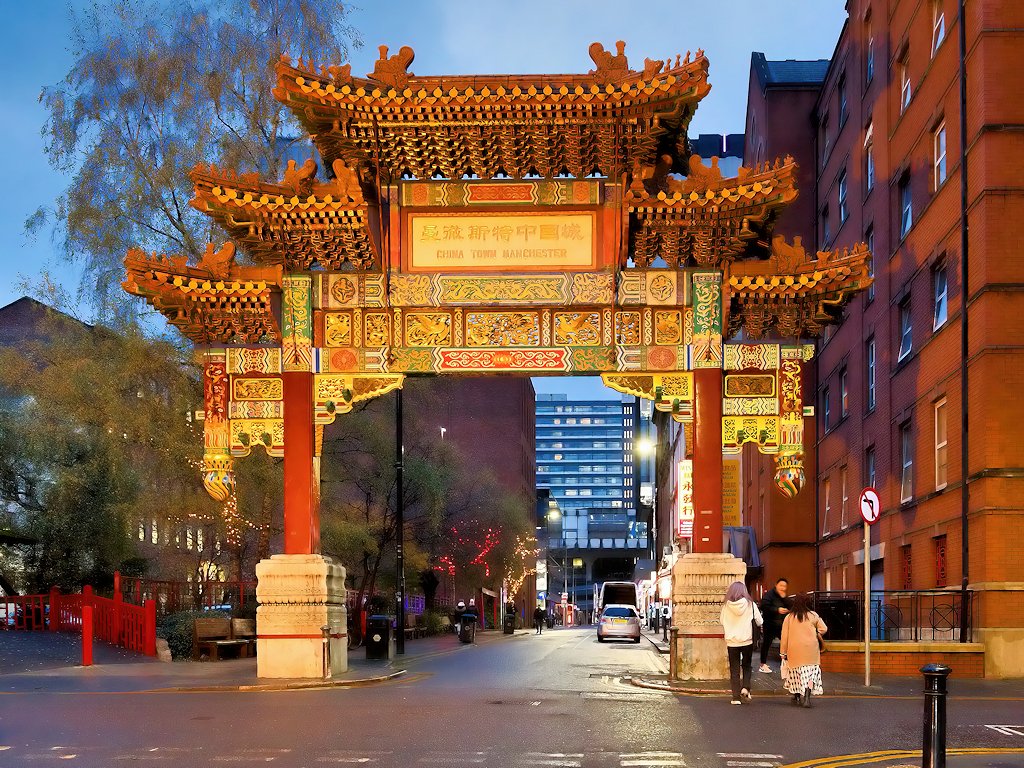
The UK's second largest Chinatown after London; the 1987 Imperial Chinese Archway on Faulkner Street; Manchester's annual Chinese New Year celebrations.
Image: The Imperial Chinese Arch on Faulkner Street in Manchester Chinatown by David Dixon (CC BY-SA 2.0)
Manchester's Chinatown is centred on Faulkner Street, between Portland Street and Princess Street in the southern part of the city centre, close to Piccadilly Gardens and the Gay Village. It is generally recognised as the second largest Chinatown in the United Kingdom after London's, and one of the oldest Chinese communities in Europe, with roots going back to Chinese sailors and laundry workers settling in the area from the late nineteenth century onwards, followed by larger waves of migration through the twentieth century.
The area's best-known landmark is the Imperial Chinese Archway on Faulkner Street, a traditional paifang gateway completed in 1987. It was built in China and shipped to Manchester in sections before being assembled on site, and at the time of its construction was described as the largest of its kind built outside China. The archway remains the visual symbol of the district and marks the pedestrianised heart of Faulkner Street, which runs between Chinese and other East and Southeast Asian restaurants, supermarkets, bakeries and other independent businesses.
Chinatown sits within a compact grid of streets including George Street, Nicholas Street and the southern end of Faulkner Street, layered into what was originally a Georgian and Victorian merchants' quarter of warehouses, some of which survive as backdrop architecture to the current Chinese and East Asian businesses that occupy their ground floors. Yang Sing, one of the longest-established and best-known Chinese restaurants in the city, operates from the area and is frequently cited as one of the anchor businesses of the district. The Centre for Chinese Contemporary Art, formerly the Chinese Arts Centre, has also been based in this part of the city, focused on contemporary art by artists of Chinese and East Asian heritage.
Manchester's Chinese New Year celebrations, one of the largest outside Asia, are centred on Chinatown and the surrounding streets each year, typically involving a lion dance procession and street festivities that draw crowds from across the city and region. The event is a fixture of the city's annual cultural calendar rather than a one-off occurrence, and is one of the clearest examples of Chinatown functioning as a genuine cultural and community centre rather than only a dining destination.
Chinatown's position in the city centre, wedged between the main shopping streets around Market Street and Piccadilly Gardens to the north and the Gay Village around Canal Street to the south, makes it one of the most walkable and central of Manchester's distinct neighbourhoods. It is compact enough to cross on foot in a few minutes, with its identity concentrated overwhelmingly on Faulkner Street and the archway itself rather than spread across a wider area.
This guide covers what is verifiable about Chinatown now: its history as one of the UK's oldest and largest Chinese communities, its archway landmark, and its role in the city's annual Chinese New Year celebrations, rather than a changeable list of which restaurants are currently open on Faulkner Street. No current, independently verified list of trading restaurants and shops was compiled for this guide, and readers should check current listings directly before visiting.
Written and last reviewed 10 Sep 2026 by Group CEO
Save the area, share a meeting point, or build a simple local loop from real places already on this page.
An orientation loop built from listings on this page, not live directions. Open each stop for current details.
Nothing here matches that. Clear the filters to see everything in Chinatown, or search the whole city.
Details checked 10 Aug 2026
Faulkner Street roast specialist, family run since 1982. Hong Kong style roast duck and char siu in the window, and usually a queue on the pavement.
Cantonese restaurant on George Street, open since 1987 and separate from the larger Yang Sing. Cantonese standards plus a long list of chef's specials.
Long-standing Cantonese restaurant on George Street that keeps serving well after most of Chinatown has shut. Two floors, big tables, late kitchen.
3 mapped locations in Chinatown
Schematic plot of the listed locations. It is not a street map and is not to scale.Open the full map
Background for getting your bearings in Chinatown.
Ranked by how much is listed in each, not by distance.
This page is short of an event and a story for Chinatown. If you know one, add it and we will check it.
Nothing here opens a new form. Every link goes to a page the site already runs.
Optional analytics and advertising cookies, only with your consent. Cookie Policy (opens in a new tab)