
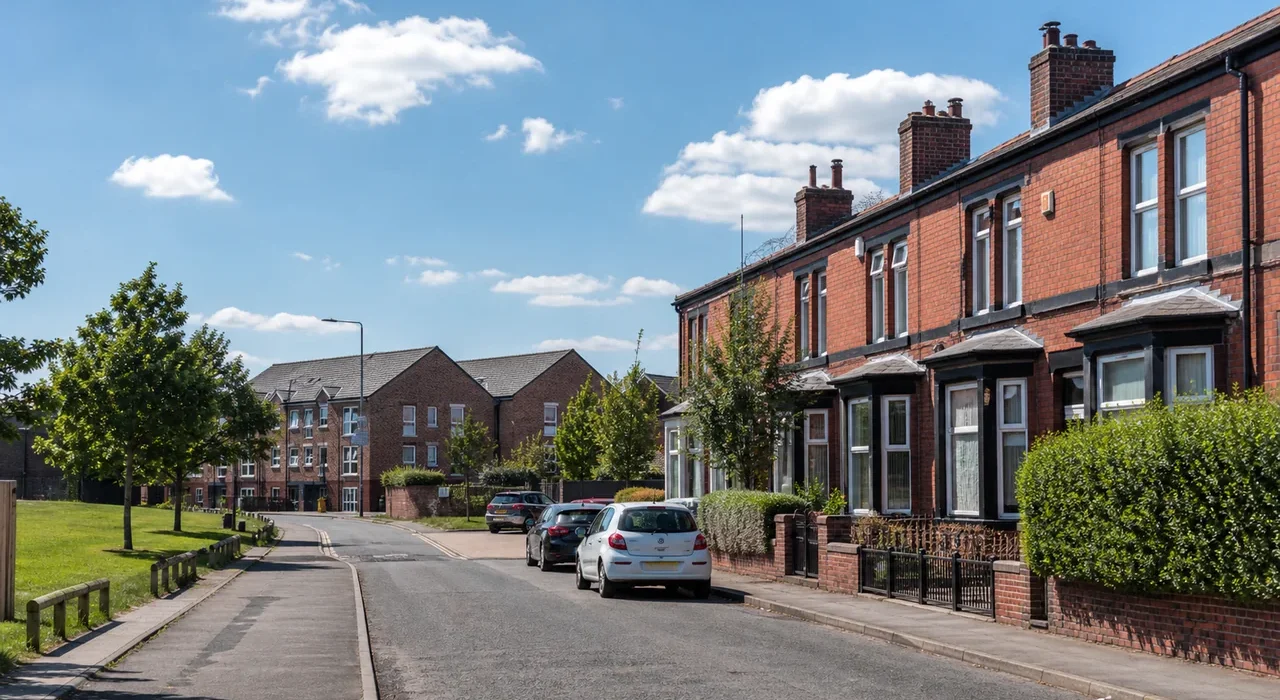
Collyhurst sits north of the NOMA district and the Manchester Victoria station area, between the inner ring and Harpurhey. It’s one of the parts of inner Manchester where the postwar housing history is most visible: the streets of Victorian terraces were cleared in the 1950s and 1960s and replaced with tower blocks and deck-access flats that became problematic within a decade and were themselves demolished or refurbished from the 1980s onwards.
The Housing History
The Collyhurst flats and towers were a product of the same postwar enthusiasm for high-rise housing that produced the Hulme Crescents – the belief that vertical density could replace Victorian terraces with modern amenity. The reality was tower blocks with inadequate heating, failing lifts, and social isolation. The clearance and replacement of the Collyhurst high-rise stock has been going on for decades and continues into the 2020s, with new-build housing replacing the demolished towers.
The Community
Collyhurst has a predominantly white working-class community with an established Irish heritage – the Irish immigration wave to inner north Manchester in the nineteenth and early twentieth centuries left its mark in the church provision and community organisations. Several Catholic churches that still serve the community were built by and for Irish families who settled in this part of the city from the 1840s onwards.
Proximity to NOMA
The NOMA development (Northern Quarter-adjacent, around the Co-op Group’s Manchester headquarters) pushes up to Collyhurst’s southern edge. The transition from the new-build offices and apartment blocks of NOMA to the traditional Collyhurst streets is abrupt and illustrative of the two-speed nature of Manchester’s development. The coffee shops of the Northern Quarter are a ten-minute walk from streets that have seen very little of the investment that’s transformed the city centre.
Related Manchester guides
Corrections
Spotted something wrong? Send a correction.